IMEI Tampering Can Lead to 3 Years in Jail and ₹50 Lakh Fine, DoT Warns Mobile Users
- Tech Awareness
- (Asia/Kolkata)
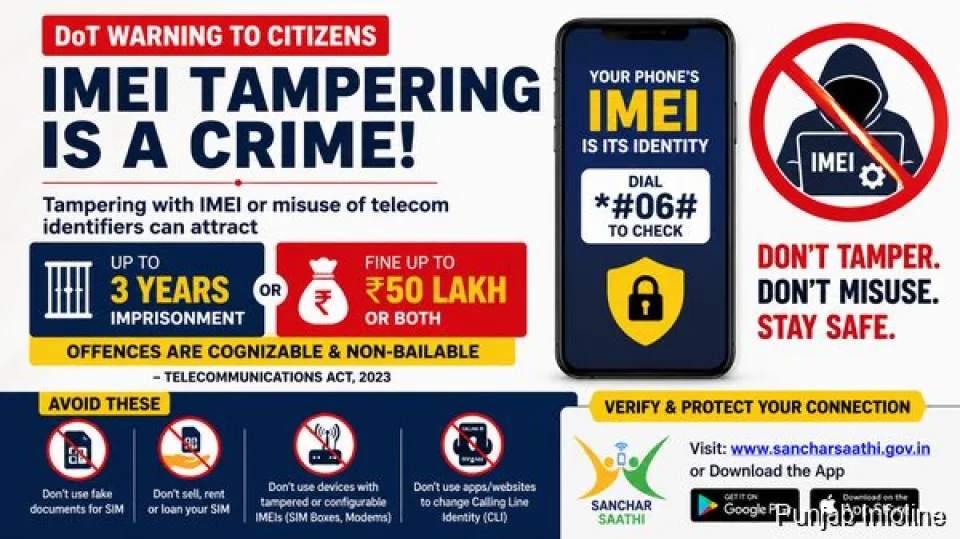
New Delhi, August 31, 2026: The Department of Telecommunications (DoT) has cautioned citizens against tampering with IMEI numbers and misusing other telecommunication identifiers, warning that violations can result in imprisonment of up to three years, a fine of up to ₹50 lakh, or both.
The advisory is particularly relevant as smartphones, SIM cards and connected communication devices become increasingly important for banking, digital payments, identity verification and everyday communication.
According to the DoT, tampering with an IMEI or using devices carrying unauthorised or manipulated telecommunication identifiers can affect citizen safety as well as the security and integrity of telecom networks.
What Is an IMEI Number?
IMEI stands for International Mobile Equipment Identity.
It is a unique identifier associated with mobile equipment and helps telecom networks identify devices. It should not be confused with a mobile phone number or SIM number.
On many phones, users can view the IMEI by dialing:
*#06#
The IMEI may also be available in the phone's settings and on the device packaging.
Users should avoid unnecessarily publishing or sharing their IMEI number online.
What Does the Law Say About IMEI Tampering?
According to the DoT advisory, the Telecommunications Act, 2023 contains provisions dealing with tampering and fraudulent use of telecommunication identifiers.
The department specifically cited Section 42(3)(c) concerning tampering with telecommunication identifiers and Section 42(3)(e) concerning obtaining SIMs or telecommunication identifiers through fraud, cheating or impersonation.
DoT said violations can attract:
- Up to three years' imprisonment
- Fine of up to ₹50 lakh
- Or both
The department also stated that such offences are cognizable and non-bailable under Section 42(7).
People who abet or promote these offences can also face liability under the provisions cited by the department.
SIM Cards Can Create Problems Too
The warning is not limited to changing an IMEI.
DoT has also cautioned people against obtaining SIM cards using fake documents, fraud, cheating or impersonation.
Another important warning concerns SIM cards legitimately issued in someone's name.
Citizens should not sell, rent, loan or otherwise provide such SIM cards to people who may use them for cyber fraud or other unlawful activities.
A SIM registered in your name should therefore be treated as an important digital identity asset rather than something that can casually be handed to another person.
Be Careful When Buying a Used Smartphone
The advisory also highlights an important issue for people purchasing second-hand mobile phones.
Before buying a used device, consumers should verify that its identity and device information appear legitimate.
This is where the government's Sanchar Saathi service can be particularly useful.
How to Verify a Phone Through Sanchar Saathi
The DoT encourages citizens to use the Sanchar Saathi platform to verify and secure their mobile handsets and connections.
According to the department, citizens can use the service to check information associated with a handset's IMEI, including details such as its:
- Brand
- Model
- Manufacturer information
Visit the official Sanchar Saathi Portal: www.sancharsaathi.gov.in
The service is also available through official mobile apps.
Android: Sanchar Saathi on Google Play
iPhone: Sanchar Saathi on the App Store
What Should Mobile Users Avoid?
Based on the DoT advisory, citizens should avoid:
- Using or procuring devices with configurable or tampered IMEIs.
- Obtaining SIM cards through fake documents, fraud, cheating or impersonation.
- Selling, renting, loaning or transferring SIM cards for misuse.
- Using mobile apps, websites or other methods to modify Calling Line Identity or other telecommunication identifiers.
- Using or assembling modems, modules, SIM boxes or other equipment with unauthorised or manipulated identifiers.
People dealing with equipment such as SIM boxes, modems and communication modules should be particularly careful about compliance requirements.
CYPEE Tech Awareness: IMEI vs SIM vs Mobile Number
These three identifiers are often confused.
IMEI identifies the mobile equipment.
SIM identifies a subscriber connection on a mobile network.
Mobile number is the telephone number associated with the connection.
Understanding the distinction is useful because replacing a SIM card does not ordinarily change the handset's IMEI.
What Should You Do Before Buying a Second-Hand Phone?
Before paying for a used smartphone:
- Check the IMEI displayed by the handset.
- Compare relevant device details with the phone and available documentation.
- Verify the handset through Sanchar Saathi.
- Be suspicious if device identity information does not correspond with the phone being sold.
- Avoid purchasing devices whose origin or ownership appears questionable.
These precautions can reduce the risk of buying a handset with problematic or manipulated device identification.
Why This Matters
IMEI and SIM misuse is not merely a technical issue. Telecommunications identifiers can play an important role in network security, device identification and investigations involving fraudulent activity.
The DoT says the legal framework is intended to prevent telecom-related fraud and strengthen the safety and integrity of India's telecommunications ecosystem.
For ordinary consumers, the practical lesson is simple: do not attempt to modify a phone's IMEI, do not obtain SIM cards using false information, do not provide your SIM to someone for questionable use, and verify unfamiliar or second-hand devices before purchasing them.
Source: Department of Telecommunications, Government of India, release dated August 31, 2026.